
Imagine waking up after a night of heavy rain in Nottingham only to find a yellowed, spreading circle directly above your bed. Discovering a damp patch on ceiling after rain is a stressful experience that brings immediate concerns about escalating repair costs and potential damage to your furniture or electrics. It’s a frustrating situation, and it’s often difficult to know whether you should call a plumber, a decorator, or a specialist roofer to fix the issue before the next storm hits.
At Archers Roofing Services Ltd, we believe that clarity is the best cure for the stress of property maintenance. With over 20 years of experience serving homeowners across Nottinghamshire, Derbyshire, and Leicestershire, we’ve seen how a small leak can quickly become a major headache if left unaddressed. We’re here to help you identify the source of your ceiling leak and learn exactly how to protect your home from further water damage. This guide covers the common culprits, from slipped tiles to perished leadwork, giving you the knowledge to move from uncertainty to a dry, secure home.
Key Takeaways
- Identify the difference between penetrating damp and simple condensation to ensure you’re addressing the correct root cause.
- Discover why a damp patch on ceiling after rain is frequently caused by easily fixable issues like slipped tiles or perished leadwork.
- Learn the essential immediate steps to take during a downpour to protect your furniture and prevent a ceiling collapse.
- Understand why a comprehensive professional inspection is the only way to find hidden vulnerabilities across your entire roof.
- Find out how to access expert roofing repairs and free 24-hour quotes for properties across Nottingham, Leicestershire, and Derbyshire.
Why Rain Causes Damp Patches on Your Ceiling
Living in the East Midlands means our homes face significant exposure to wind-driven rain. This horizontal pressure often forces moisture into tiny gaps that would stay dry during a light drizzle. When you notice a damp patch on ceiling after rain, you’re likely dealing with penetrating damp. We define penetrating damp as water ingress through structural defects like cracked tiles or failed leadwork. Unlike other forms of moisture, this is a direct result of the building’s external envelope being bypassed.
If left unaddressed, this moisture can lead to significant water damage within your attic and living spaces. It isn’t just an aesthetic issue; it’s a sign that your property’s primary defence is compromised. Whether it’s a minor drip or a major leak, we treat every call-out with the same urgency, as even small defects can compromise the integrity of your home over time.
The Difference Between Condensation and Penetrating Damp
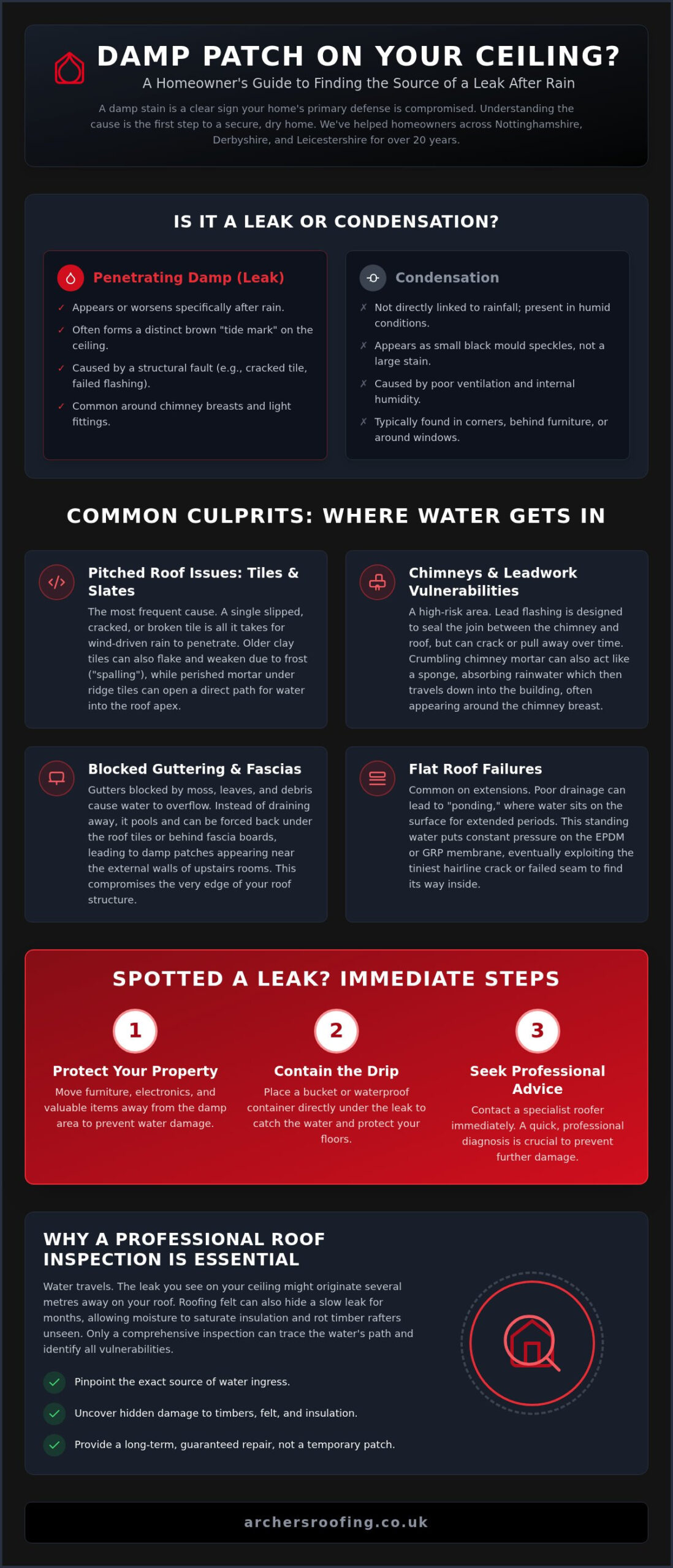
It’s vital to distinguish between a leak and simple condensation. Condensation is usually a ventilation issue and appears as small black mould speckles, often in corners or around windows. In contrast, a damp patch on ceiling after rain usually manifests as a distinct brown tide mark. Timing is the biggest giveaway. If the mark only darkens or grows during a downpour, it’s almost certainly a roofing issue rather than internal humidity. Leaks often concentrate around chimney breasts or light fittings where the roof structure is most vulnerable.
How Water Travels Through Your Roof Space
Water rarely takes a straight path. Through a process called tracking, rain can enter through a slipped tile on one side of the house and run along a timber rafter before finally dripping onto your plasterboard several metres away. This makes finding the source difficult for the untrained eye.
Roofing felt can also hide leaks for months, acting as a secondary skin that collects water until it eventually perishes or overflows. By the time you see a stain on your ceiling, the moisture may have already begun to saturate your insulation or rot your timber rafters. We’ve seen many cases in Nottingham where early intervention could have saved homeowners from more extensive structural repairs. Our team provides free inspections and quotes within 24 hours to help catch these issues before they escalate.
Common Culprits: Where is the Water Getting In?
Pinpointing the exact entry point of a damp patch on ceiling after rain is the first step toward a permanent fix. Water is opportunistic. It will find the path of least resistance through your roof’s defences. In our experience across Nottingham and the surrounding counties, the source of a leak usually falls into one of four categories: tiles, leadwork, guttering, or flat roof membranes.
Pitched Roof Issues: Tiles and Slates
Slipped or broken tiles are the most frequent cause of water ingress in local homes. Many older properties in Nottinghamshire feature clay tiles that eventually suffer from spalling. This happens when moisture gets into the tile and expands during a frost, causing the surface to flake and weaken. We also keep a close eye on ridge tiles at the very top of your roof. If the mortar has perished, these tiles can become loose and allow rain to blow directly into the roof apex. You can find more detail on these specific faults in our pitched roof guide.
Chimneys and Leadwork Vulnerabilities
The junction where a chimney stack meets your roof is a high-risk area. We often find that a damp patch on ceiling after rain appears specifically around the chimney breast. This usually points to failed leadwork. Lead flashings, valleys, and gulleys are designed to channel water away from joins, but they can crack or pull away from the brickwork over time. If the mortar in the chimney stack itself is crumbling, rain can also soak through the bricks and travel down the flue. Professional repointing is often the best way to secure these masonry gaps.
Guttering and Roofline Protection
Your gutters and fascias do more than just move water; they protect the edge of your roof. When gutters become blocked with moss or debris, the water has nowhere to go. It pools and eventually forces its way under the bottom row of tiles or behind the fascia boards. This often results in damp patches appearing near the external walls of your upstairs rooms. Maintaining these components is vital for long-term protection. Our fascias and guttering guide provides a checklist for spotting these roofline failures early.
For those with flat roof extensions, we look for signs of “pooling” or “ponding.” If water sits on an EPDM or GRP surface rather than draining away, it eventually finds its way through even the smallest hairline crack. If you’ve spotted a new mark on your ceiling, we can provide a free roof inspection to identify the culprit before the next storm arrives.
What to Do When You Spot a Leak After a Downpour
Seeing a damp patch on ceiling after rain is alarming, but the actions you take in the first hour can save you thousands of pounds in restoration costs. Your first priority is containment. Place buckets directly under the drip and lay absorbent towels on the floor to prevent water from soaking into your carpets or floorboards. If you catch the water early, you can often avoid the need for expensive flooring replacements later.
If the ceiling is bulging or the plaster feels soft, the paint is likely holding back a significant volume of water. We recommend the “small hole” trick: use a screwdriver or a small drill bit to carefully poke a hole in the centre of the bulge. This relieves the hydraulic pressure and allows the water to drain into your bucket. It may seem counterintuitive to damage your ceiling further, but this controlled release often prevents a catastrophic ceiling collapse.
Safety remains the priority during any leak. If the moisture is near a light fitting or a socket, turn off the electricity at the consumer unit immediately. Do not touch switches or appliances in the affected room until a professional has confirmed they’re dry and safe to use.
Immediate Steps for Homeowners
Once the water is contained, move all furniture and valuables to a dry part of the house. If it’s safe to do so, check your loft space with a torch. You might see water tracking down a rafter or pooling on top of your insulation. Document everything with clear photos. These images are essential for any potential insurance claim and help our team diagnose the fault quickly when we arrive for an inspection.
Avoid the temptation to go on the roof yourself. Wet tiles and slates are incredibly slippery, and the risk of a fall far outweighs the benefit of a temporary DIY fix. It’s always safer to wait for a professional team with the correct safety equipment and ladders.
When to Call for Emergency Roof Repairs
While some leaks are minor, others require immediate professional intervention. Signs of structural sagging, large-scale water ingress, or multiple leaks across different rooms shouldn’t be ignored. We specialise in emergency roof repairs throughout Nottingham and the surrounding areas, providing the rapid response needed to protect your investment.
We understand the stress a leaking roof causes. That’s why we offer a 24-hour quote guarantee for all urgent assessments. Whether it’s a few slipped slates or a failed flat roof membrane, our team is ready to act. If you’re worried about a new damp patch on ceiling after rain, you can request a free quote today, and we’ll help you secure your home against the elements.
Professional Roof Repairs and Long-Term Prevention
While the immediate priority is stopping the water, a permanent fix requires a comprehensive assessment. When we investigate a damp patch on ceiling after rain, we look beyond the obvious entry point. Our inspections cover the entire roof structure to identify hidden vulnerabilities that could lead to future leaks. This might include checking the integrity of traditional Nottingham clay tiles or assessing the weathering on Derbyshire slate roofs, which have different wear patterns than modern materials.
We pride ourselves on an honest, no-nonsense approach. If a small, targeted repair to your leadwork or guttering will solve the problem, that’s what we’ll suggest. No job is too small for our team, and we don’t believe in recommending a full replacement if a repair will suffice. Every repair we perform is fully guaranteed. This provides the security property owners need when dealing with the unpredictable East Midlands weather. Regular maintenance checks are a cost-effective way to catch these issues before they turn into expensive interior damage.
Archers Roofing: Your Local Nottingham Specialists
Established in 2001, we bring over 20 years of experience to every technical task. Based in Kinoulton, our team has built a reputation for punctuality and tidiness across Nottinghamshire, Derbyshire, and Leicestershire. We’ve mastered everything from intricate leadwork on period properties to modern flat roofing systems. Our local knowledge means we understand the specific challenges faced by homes in this region, ensuring our repairs are built to last.
Next Steps: Get Your Free Inspection
Don’t let a small stain become a major structural concern. We offer free inspections and quotes within 24 hours to help you understand the health of your roof without any pressure. Our goal is to make your property watertight and secure before the next storm arrives. We’ll provide a clear, straightforward breakdown of the necessary work so you can make an informed decision for your home. You can request your free, no-obligation roof inspection from Archers Roofing today to get started.
Protect Your Property from Future Water Damage
A damp patch on ceiling after rain is a clear signal that your roof’s defensive layer has been breached. Whether the cause is a slipped tile or perishing leadwork around your chimney, taking immediate action prevents small leaks from turning into costly structural repairs. We’ve seen how East Midlands weather can test even the sturdiest properties; this makes early detection and professional intervention vital for every homeowner.
Established in 2001, Archers Roofing brings over 20 years of local expertise to every repair. We provide fully guaranteed workmanship and a commitment to keeping your home tidy and secure. Don’t wait for the next heavy downpour to see if a temporary fix holds up. Our team is ready to help you identify the root cause and provide a permanent solution that protects your investment for years to come.
Get a free roof inspection and quote within 24 hours from Archers Roofing. We’re here to provide the peace of mind that comes with a dry, safe, and professionally maintained roof.
Frequently Asked Questions
Will a damp patch on the ceiling dry out on its own?
While the surface moisture may evaporate during a spell of dry weather, the underlying structural issue will not resolve itself. A damp patch is a symptom of a breach in your roof’s defence. Every time it rains, the patch will likely return and expand. Left unaddressed, trapped moisture can lead to timber rot and mould growth, which eventually makes the necessary repairs far more complex and expensive for the homeowner.
How much does it cost to fix a leaking roof in Nottingham?
The cost of a repair depends entirely on the source and scale of the ingress. A minor fix, such as replacing a few slipped tiles or resealing a chimney flashing, is a straightforward task. However, extensive damage to a flat roof membrane or structural timber rot requires more significant work. We provide free inspections and quotes within 24 hours across Nottinghamshire to give you an accurate, no-obligation price for your specific repair.
Can I paint over a damp patch once the leak is fixed?
You can, but you must use a specialist stain-blocking primer first. Standard emulsion paint won’t hide the brown tide marks left by water ingress; the minerals in the water will simply bleed through your new decor. Once we’ve confirmed your roof is watertight and the plaster is bone dry, apply a dedicated damp-seal primer. This creates a permanent barrier, allowing your final coat of paint to look professional and uniform.
Is a damp patch on the ceiling an emergency?
A damp patch on ceiling after rain is always a priority, but it becomes an emergency if the ceiling is bulging or water is dripping near light fittings. If the plaster feels soft or you notice a sudden increase in water ingress during a storm, you should seek professional help immediately. We offer emergency call-out services across the East Midlands to secure properties and prevent catastrophic ceiling collapses or electrical fires.
Does home insurance cover ceiling damage from rain?
Most standard policies cover internal damage caused by “perils” like storms or sudden pipe bursts. If a heavy storm damages your roof and leads to a leak, your insurer will likely cover the cost of redecorating. However, if the leak is caused by long-term wear and tear or a lack of maintenance, such as perished leadwork or porous tiles, they may reject the claim. It’s vital to check your specific policy wording regarding penetrating damp.
How do I know if the damp is from the roof or a pipe?
The most reliable indicator is the timing of the leak. If you only notice a damp patch on ceiling after rain, the issue is almost certainly with your roofing, guttering, or leadwork. If the patch remains constant or worsens regardless of the weather, it’s likely a plumbing leak from a bathroom or heating pipe. We recommend checking your loft space during a downpour to see if water is tracking down the rafters.