Contents
- 1. Roof leaks at chimneys, valleys and shared joints
- 2. Chimney stacks and valleys shared between homes
- 3. Party wall damp caused by neighbouring gutters or downpipes
- 4. Exposed gable ends on end-of-terrace houses
- Archers Roofing Services: Emergency Roof Repairs
- Take the next step towards a sound roof
- Frequently Asked Questions
At Archers Roofing Services Ltd, we explain that a terraced-house roof can leak after heavy rain, even when the tiles look intact. Common roofing problems in terraced houses often begin around chimneys, roof valleys, gutters and joints between adjoining properties, where water can get in or fail to drain away.
We understand it’s natural to suspect a slipped or cracked tile, but the source of a leak may be further along the roof or hidden in a shared detail. We also explain that end-of-terrace homes have an exposed gable end facing the weather, leaving the roof edges and wall more vulnerable to wind and rain.
We explain how problem areas can lead to leaks, what signs to look for indoors and why damp near a shared wall may come from a gutter or roof joint. We also cover when a targeted repair may help and when several signs point to a wider roofing issue. If water is coming in, we recommend avoiding walking on the roof. Our professional assessment can identify the source and the appropriate repair.
1. Roof leaks at chimneys, valleys and shared joints
Heavy rain can expose weak points that ordinary showers miss. Around a chimney, cracked or lifted flashing can let water behind the roof covering. At a valley, leaves or damaged lining can slow drainage and push water beneath tiles. On a terraced house, adjoining roof levels and rear offsets create additional joints where moisture can enter.
Fresh staining around a chimney breast, damp patches in the loft, or daylight through roof boards can help us locate a leak. From the ground, you may spot missing or displaced slates, but don’t climb onto the roof to inspect it. During a professional survey, we check external coverings, flashing, roof timbers and the likely source. BS 5534 is identified by the British Standards Institution as the UK standard for slating and tiling.
For a replacement roof, the cost depends on roof size, access, materials and hidden damage to timbers or coverings. We provide a price after a quote request. Removing an old roof typically takes 1-2 days, while the full installation time varies with roof complexity, weather, access and repairs uncovered during the work.
When comparing roofing quotes, we recommend checking that each written scope covers the same roof areas, materials, flashing, waste removal, access and repairs. We also recommend asking to see relevant qualifications and evidence of insurance, and making sure the proposed work and exclusions are clearly recorded.
Like-for-like roof replacement in the UK does not normally require planning permission, but Building Regulations may apply. Before work begins, our survey identifies whether the planned work affects the roof structure, insulation or other regulated elements.
The Party Wall etc. Act 1996 can apply in England and Wales when work affects structures shared between properties, including party walls carrying roofs. Whether formal procedures apply depends on the proposed work, so a repair to one roof slope and work to a shared chimney may be treated differently.
Shared roofs and party walls can mean a leak affects neighbouring homes, especially where a valley or joint serves both properties. Responsibility for a shared valley depends on the title deeds and any agreements; it is not automatically shared. We recommend a joint inspection to record the affected area, proposed work, access arrangements and how owners will handle costs.
After finding a leak, we recommend moving belongings away, safely catching dripping water and noting where stains appear. Call an emergency roofer if water is entering rapidly or creating an immediate risk. Avoid accessing the roof, especially during rain or high winds.
Blocked gutters can overflow onto external walls, while roof leaks can leave moisture in ceilings, lofts and timbers. Poor ventilation can trap moist air in the roof space, increasing condensation and damp. We assess the water source, gutter drainage, insulation and ventilation together.
2. Chimney stacks and valleys shared between homes
In Victorian and Edwardian terraces, one chimney stack can serve two homes, with a separate flue for each property. The brickwork above the roofline may look continuous, but smoke from each fireplace travels through its own passage. A leak around the stack can therefore affect either roof, while staining inside one chimney breast may point to an exterior defect.
Older stacks were often built without a damp-proof course, so some dampness in the masonry can occur. That does not mean every damp patch is harmless. Rain can enter through loose mortar, cracked brickwork, an open chimney pot or failed flashing, then travel down the stack. We recommend an inspection to distinguish moisture from the chimney from condensation or a separate roof leak.
We recommend choosing chimney capping to suit the stack’s use. A redundant flue still needs suitable ventilation, because trapping damp air inside can leave moisture in the masonry. An active flue must remain open for its intended use. We recommend not blocking a flue or changing a cap without establishing whether an appliance or fireplace still uses it. Our roofing inspections can identify roof defects, while flue safety needs appropriate specialist attention.
Lead flashing forms a weatherproof junction between the chimney and roof covering. If its edges lift, crack or pull away from the brickwork, rain can enter around the stack. We recommend checking whether the repair needs to include the leadwork, adjacent tiles, mortar and underlying timbers, rather than sealing only the visible gap. Recurrent damage after repairs can indicate movement in the stack or the surrounding roof section.
We recommend paying close attention to shared valleys too. They carry water where roof slopes meet, and a blockage or damaged lining can direct rain beneath the coverings. If a valley serves both homes, we recommend arranging a joint inspection where practical and recording the affected section, access arrangements and agreed repair scope. The title deeds and any agreements can help clarify responsibility; shared ownership is not automatic.
We recommend treating structural signs as more than a surface patch. Crumbling brickwork, a leaning stack, cracked mortar or roof timbers pulling away from a wall can indicate movement or weakened support. Frequent recurrence, especially after windy weather, is a reason to assess the stack and roof structure together. We recommend keeping dated photographs and repair records, including documents needed for an insurance claim.
For leaking chimney junctions or deteriorating masonry, chimney repairs and leadwork can address the external defects contributing to water ingress. A focused inspection helps identify whether the issue sits in the flashing, brickwork, valley or supporting timbers.

3. Party wall damp caused by neighbouring gutters or downpipes
A damp patch beside a party wall can begin with rainwater escaping from a neighbouring gutter or downpipe. Water may track behind external masonry, soak into the shared wall and appear indoors some distance from the original fault. For example, staining high on a bedroom wall may line up with a leaking gutter joint rather than a defect in the room itself.
We recommend looking for a pattern after rainfall: overflowing water, a sagging gutter section, loose brackets or a downpipe discharging beside the wall. These signs can help trace the route of water before repair work starts. Damp can have other causes, so the visible patch alone does not identify the source. We can inspect the roof edge, gutter run and downpipe connections together.
Shared valley gutters can drain both homes, so a failure may affect either property. In England, Wales, Scotland and Northern Ireland, responsibility depends on the title deeds, any agreements between owners and how the damage arose. It is not automatically an equal split. If a component genuinely serves both homes, an equal contribution can be a starting point, adjusted where deterioration clearly comes from one side.
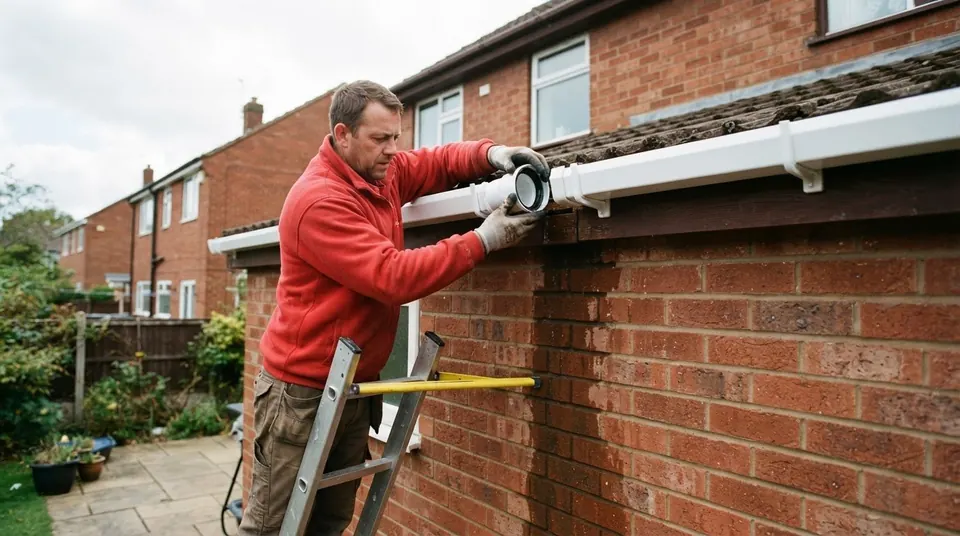
Continuous gutters running past several houses need consistent support and a clear route to an outlet. If one section sags, rainwater can collect, spill over or flow towards a neighbouring property downhill. Correctly installed gutters need a slight fall towards the downpipe, without dips that hold water. Their capacity and outlet positions should suit the roof area and the amount of rainwater they need to carry.
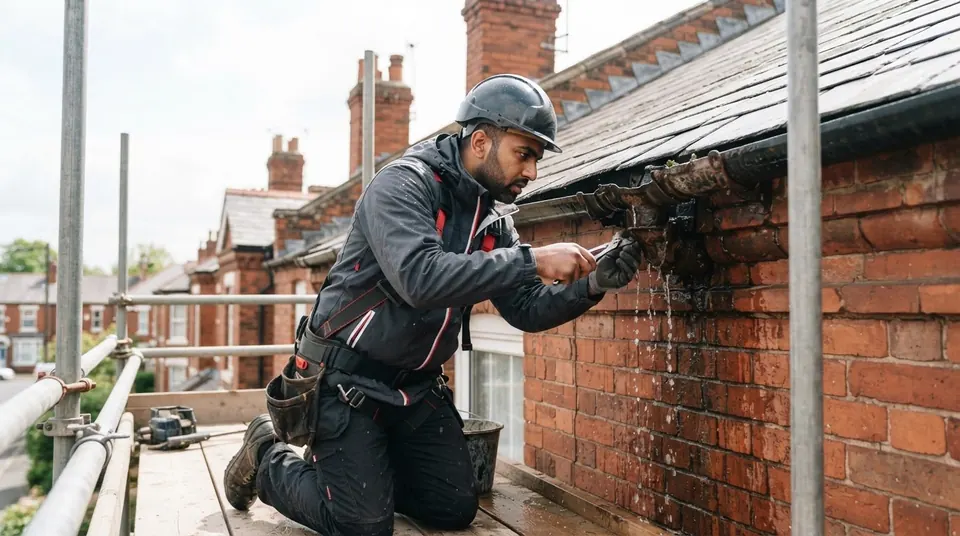
Blocked gutters and downpipes can cause similar overflow. Leaves, moss and roof debris restrict the route, while a blocked bend can stop water reaching the drain. We recommend tracing the flow from the roof edge through each outlet, then clearing any blockage and checking the system for leaks, loose joints and displaced brackets. A clean gutter that still overflows may have a poor fall, damage or inadequate drainage.
After a leak, we recommend recording where damp appears and when it worsens. Photographs of the stain, gutter and downpipe can help connect the indoor symptom with the external fault. Avoid reaching over a roof edge or using an unstable ladder. We recommend arranging a joint inspection with the neighbour to establish whether the gutter or valley serves one property or both. A written repair agreement can set out the affected section, work and cost arrangement.
Once water is entering a wall, prompt repair can help prevent ongoing moisture from affecting plaster and nearby timbers. We recommend keeping the assessment focused on the route of rainwater, not just the visible damp patch. This makes it easier to identify whether the problem is a blocked outlet, failing joint, sagging continuous run or shared valley.
4. Exposed gable ends on end-of-terrace houses
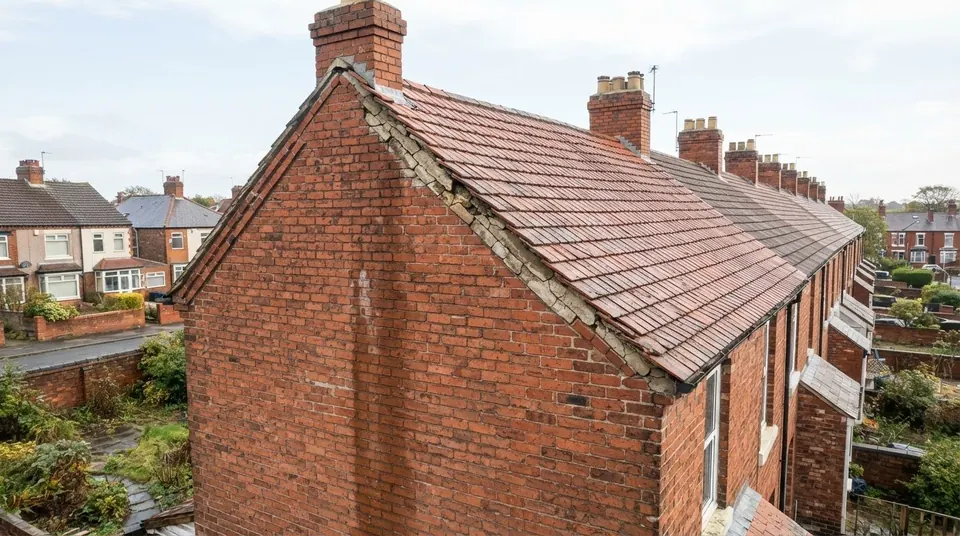
An end-of-terrace house has one external gable wall exposed to wind and rain. Mid-terrace homes are sheltered by adjoining properties, but the end wall takes more direct weather. This exposure can affect roof edges, masonry and the junction where the roof meets the gable. After heavy rain, damp near the upper corner may point to a roof defect or water entering through the wall.
We recommend starting with a ground-level visual check after bad weather. Look for slipped or cracked tiles along the gable edge, damaged verge mortar, loose coverings or cracks in the exposed brickwork. These signs do not prove the leak’s route, but they can help us target an inspection. Don’t climb onto the roof. Water can travel along rafters or other timbers before showing as an indoor stain.
Victorian terraces need particular attention to their roof supports. A purlin is a horizontal timber that supports the rafters; its end may rest on or near the party wall. If the brickwork is crumbling or the timber shows signs of rot, the support may be weakened. When we assess a leak, we consider the structure, not just the visible tiles. Safe repairs may sometimes require access across a wider roof area.
We recommend carefully inspecting the roof-to-wall junction. Check the edge covering, mortar and any flashing for gaps or movement. If a rear valley meets the gable or another roof slope, water must drain freely without crossing a failed junction. During replacement work, we can survey the condition of these details, roof timbers and the exposed wall, so concealed damage is not overlooked when coverings are removed.
Insulation and ventilation also matter during roof repairs or replacement. Insulation helps limit heat loss, but a roof space still needs suitable airflow to reduce condensation. Trapped moisture can affect roof timbers and make it harder to distinguish condensation from rainwater ingress. We recommend considering insulation, ventilation and the external roof covering together, rather than treating a damp patch as proof of one specific fault.
The London Building Act of 1774 required terraced houses to have a party wall extending above the roofline, helping prevent fires spreading between homes. That historic feature doesn’t make an exposed gable weatherproof. Cracked masonry, damaged roof edges and failing supports still need attention. We recommend a clear inspection to identify which defect is allowing water in and whether the repair affects the roof edge, wall or structural support.
If a leak appears beside an exposed gable, we recommend arranging a professional roof assessment before the damage spreads into timbers or internal finishes. We can inspect the edge, coverings, valley and support points, then explain the repair needed. Arrange an assessment of your roof to identify the source and plan the next step.
Archers Roofing Services: Emergency Roof Repairs
Archers Roofing Services Ltd can help when a leak needs urgent attention or a chimney, valley or exposed gable is letting in water. We carry out emergency roof repairs and assess whether the fault needs a focused repair or work to pitched or flat roofing. Our leadwork service can address leaking roof junctions.
For homeowners and commercial property owners in Nottingham, Nottinghamshire, Leicestershire and Derbyshire, we provide free quotes within 24 hours. Completed work is fully guaranteed, and our team aims to be punctual, professional and tidy on site.
If water is entering your property or you’ve noticed roof damage, contact Archers Roofing Services Ltd to discuss the repair.
Take the next step towards a sound roof
A roof leak doesn’t always start where water appears indoors. If you’ve noticed damp, a drip after heavy rain or damage near a roof edge, an assessment can help establish what needs attention before the problem spreads. Understanding common roofing problems in terraced houses is useful, but the next step is identifying the fault on your property and deciding which repair will address it.
Where a roof detail affects adjoining homes, clear communication can help keep the repair practical. We can assess pitched and flat roofs, inspect leadwork, and explain the work needed in straightforward terms. Archers Roofing Services Ltd works with homeowners and property owners across Nottingham, Nottinghamshire, Leicestershire and Derbyshire.
If you’re concerned about a leak or visible roof damage, contact Archers Roofing Services Ltd today to discuss the next step. A clear assessment can help you move forward with confidence and protect your property.
Frequently Asked Questions
What causes roof leaks after heavy rain?
We find that heavy rain can reveal gaps in roof coverings, flashing, valleys or gutter connections. Wind can drive water beneath a loose tile, while overflowing rainwater may enter around roof edges or adjoining walls. A leak can appear away from its entry point, so we recommend noting which room or ceiling area gets wet and whether it happens only in particular weather. These details can help us narrow down the source.
When does a terraced-house roof need replacing?
We may recommend replacing a roof when problems persist or spread across several areas, rather than being limited to one repairable fault. Warning signs include recurring leaks, missing or cracked tiles, sagging sections, heavy moss build-up or daylight through roof boards. We can assess the coverings and supporting structure together. The roof’s condition, materials and any hidden damage help us determine whether replacement is appropriate.
What are the most common roofing problems in UK terraced houses?
We commonly see slipped or cracked tiles, worn roof felt, leaks around chimneys and valleys, blocked gutters, and defects where adjoining roofs meet. End-of-terrace homes also have an exposed gable facing the weather. Frequent slipped slates can point to tired fixings or deteriorated roof components, rather than one loose slate. We can inspect the roof to distinguish a local fault from problems affecting a wider area.
What causes roof leaks and damp in terraced houses?
We find that leaks can start with damaged coverings, failed flashing or rainwater escaping from a gutter or shared valley. Damp can also result from condensation when moist air builds up in a roof space with inadequate ventilation. For example, a stain that appears during rainy weather may suggest water ingress, while recurring moisture without rain can indicate condensation. We consider both possibilities in a roof assessment before planning repairs.
How much do common terraced-house roof repairs and roof replacement cost in the UK?
We base repair and replacement costs on the affected roof area, materials, access and whether the work uncovers damage to the supporting timbers. A small local repair differs from replacing coverings across the roof, especially where chimneys, valleys or adjoining sections add complexity. We provide a quote based on the individual work required. Our written quote clearly describes the work included.